

PulseLoop Turns A $7 AliExpress Ring Into A Privacy-First Health Coach
Saksham Bhutani reverse-engineered a cheap Bluetooth smart ring's BLE protocol and built a SwiftUI iOS app that pairs the raw sensor data with an on-device AI coach, no subscription or cloud account required.
TL;DR
A $7 smart ring plus an AI coach, no subscription needed
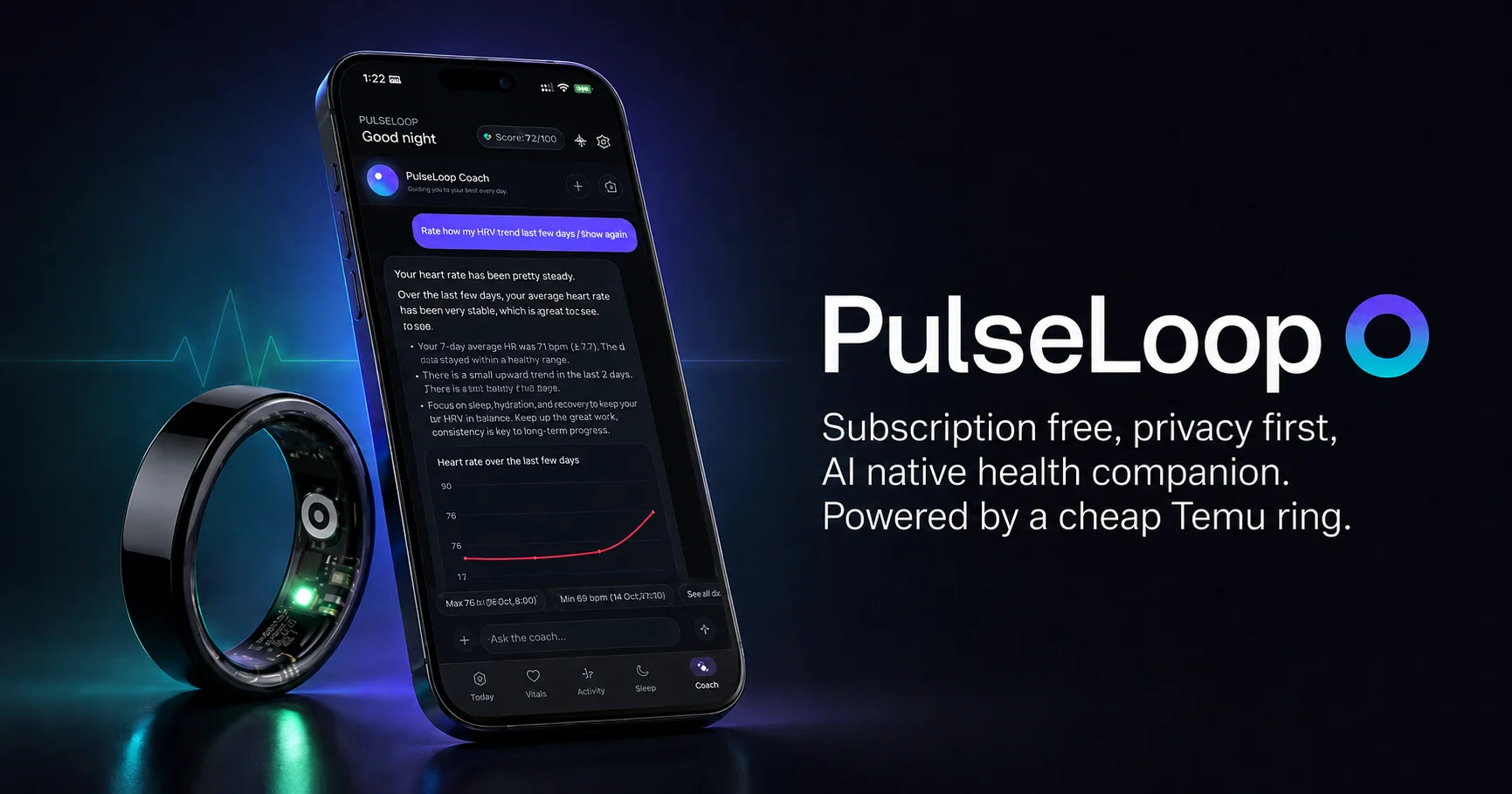
Saksham Bhutani liked the idea behind Fitbit’s new AI coaching features but not the £100 hardware, £10-a-month subscription, or handing Google a continuous feed of his heart rate and sleep — so he reverse-engineered a $7 AliExpress smart ring and built his own coach app around it.
What They Built
PulseLoop is a native SwiftUI iOS app that pairs a cheap Bluetooth smart ring (the generic Jring and Colmi/Yawell R0x/R1x/H59 family) with a local-first health dashboard and an agentic AI coach. There’s no backend, no account, and no vendor cloud — vitals, sleep, activity, and workout data all live in an on-device SwiftData store, and the only thing that ever leaves the phone is the specific data slice the coach needs to answer a question, sent under your own API key.
How They Did It
The ring runs everything over a single custom GATT service with no encryption, which is what made reverse engineering it tractable in the first place — every frame is a fixed 20 bytes, with the command ID in byte zero. Bhutani built a CoreBluetooth client that scans, connects, and serializes commands so responses come back in order, plus a sync coordinator that knows the ring’s startup sequence and how to time heart-rate and SpO2 readings around the hardware’s warm-up windows. The AI coach sits on top as a bounded agentic loop: the model gets a small context packet and a fixed toolset — read-only retrieval tools, deterministic analysis tools for trends and correlations, charting, memory, and action tools — and has to actively query for the data it needs rather than being handed a raw dump, with risky actions like deletions gated behind an explicit confirm step.
Why It’s Worth Your Time
It’s a solid blueprint for anyone annoyed at subscription wearables: the privacy model isn’t a settings toggle or a policy promise, it’s just where the bytes physically live. And the BLE protocol notes are published separately, so adding support for other cheap rings is a real open contribution path, not just a one-off hack.
Go See It
Bhutani wrote up the full project with architecture diagrams, the code is on GitHub, and his ring protocol notes and CLI are there for anyone reverse-engineering a different cheap ring.
Comments
No comments yet — be the first.